Great Scott, It is Time to Retire!!

Christopher Lloyd

Christopher Lloyd

Thirty-seven years in the finance business is coming to an end April 29th 2011.  While I have been planning for retirement since my very first job, the year 2000 attempt was thwarted by the bursting tech bubble.  After a few more years retirement was again delayed by the financial crisis in 2009.  Timesawastin’ and there’s a world to explore with camera in hand.  If one waits for everything to be perfect with no risk involved, we would be frozen with indecision.  Things to do list includes make insurance decisions, sell car, buy truck, downsize through EBay and Craig’s List, travel to New Mexico from Chicago via Route 66.

See you there…..

Antelope Canyon, “Our Lady of the Canyon” photo background

AZ02-good-Our-Lady-of-the-Canyon-

“Our Lady of the Canyon” photograph, in my Arizona Portfolio, was taken in Antelope Canyon, a small sandstone canyon carved by wind and water erosion over millions of years, located on the Navajo Reservation in Northern Arizona. This photo recently won 2nd place out of thousands of entries at the Hubbard Museum Fall Photo Contest in New Mexico.  This location is known as a “slot” canyon and may only be three feet across when viewed from above, but is over 100 feet from the rim to the natural floor.

Reflected light bounces off of the canyon walls, resulting in tones from bright gold near the most intense light, to soft blues where the light is more diffused.  At high noon shafts of sunlight pierce through the openings at the canyon top to the floor below.  Wind blowing the sand into the canyon illuminates these sunbeams.  Most often one simply sees a beautiful ray of light.  But as captured in this fine art photograph, a figure of a woman wearing a headscarf and outstretched arms is very visible in the fourth photo of this sequence, “Our Lady of the Canyon.”  In the actual photograph, if you look closely, you can see the streaks of sand falling.  Long exposures and a tripod are required to capture the light in this canyon.  Below are the photographs that led up to this once-in-a-lifetime image.

Continue reading

Photo Manipulation – Ansel Adams, “The Making of 40 Photographs”

(Six in Series of Six discussions on Photo Manipulation)

This is a wonderful book written by Ansel Adams in 1983.  He selected 40 of his well-known photographs and goes into several pages of description for each of how he came upon the scene, went about capturing it as well as printing details and difficulties.  Keep in mind that if every photo was printed without adjustments or manipulation, there would be no printing issues to discuss, since one would simply expose the photo paper for a few seconds and that would be it.

Ansel Adams Winter Sunrise

Winter Sunrise, the Sierra Nevada, from Lone Pine, California 1944

©The Trustees of the Ansel Adams Publishing Rights Trust

Scan courtesy of Masters of Photography

Continue reading

Photo Manipulation – Ansel Adams and Group f/64

Ansel Adams (1902 – 1984)

(Fifth in a series of six articles)

First, it needs to be noted I am not making a comparison between my photography work or skills to that of Ansel Adams. He is the subject here simply because of his popularity the admiration so many share for his popular works of art . I greatly admire his photographs as does most of the professional photographic community today.

Radical may be too strong of a word for Ansel Adams and his small group of photographer friends in the early 1930’s but they did represent an opposite view of photography than what was generally accepted at the time. This group of seven California photographers formed Group f/64 as an opposing point of view from the dominating New York pictorialist photographers of the time such as Alfred Stieglitz.

Continue reading

Photo Manipulations – Human Eye vs. the Camera

(Fourth in a series of six articles)

????????Camera LensPart of the RAW file processing can be to get the image to look more like what was viewed at the time the shutter was clicked. The human eye is much more sensitive to light than the typical high end cameras of today. We can all look at our feet under our dark desks and see some detail in the shoes then immediately look up at the bright overhead lights and see some detail next to the light bulbs. No camera can capture this same range of light in a single photo.

Continue reading

Photo Manipulations – RAW Image Format vs. JPEG

(Third in a Series of Six Articles)

Gay-Paraita-D-20110630-YH6D0389_90_91_92_tonemappedMost commonly today when people take photos of friends or family, the photos will be stored in a format called JPEG.  This simply means that their camera has a math program in a computer chip where certain pieces of photo information are saved; color saturation may be enhanced while other data from the original photo are tossed out and forever lost.  Inherent in this process is a lower quality image that is not suitable for the highest quality photos required by professionals.  This math program will apply saturation to the colors automatically and will try to get whites to look white to the viewer along with many more adjustments, or manipulations.   The advantage is the resulting photos are fine for displaying on the internet and also small enough for convenient storage.

RAW image files have come to the rescue of the serious photographer who wants to take the highest quality images possible.  With a RAW file, the substantial amounts of data lost in the JPEG files are instead retained and remain unaltered.  The result is a dull image compared to a JPEG enhanced program.  Each camera manufacturer has its own proprietary format.  Nikon uses a different RAW format than Canon.   The primary difference with the RAW photo is data is not manipulated or altered by some predetermined math program trying to create a final image.  A RAW file is an unprocessed file and is not capable of being printed without alterations through computer software.

Continue reading

Photo Manipulation – Photojournalism vs. Fine Art Landscape Photography

Altered Kent State Photo

Altered Kent State Photo

Original Kent State Photo

Original Kent State Photo

(Second in a series of six articles on photo manipulation)

When looking at beautiful photographic prints created today, the question of manipulation often comes up.  Many consumers have a preconceived notion that manipulating a photo is unacceptable and have the mistaken belief that the best photographers do not manipulate their photos.  That hard and fast rule of never manipulating a photo applies only to documentary photography.  The reputation of magazines, newspapers and the photojournalist can be forever tarnished when they manipulate their photos.  An example of this was the 1970 Pulitzer Prize winning photo by John Filo which shows a student, Mary Ann Vecchio, kneeling over the body of a fellow student Jeffrey Miller shot in the Kent State University riot. Study the photos, can you see what was altered or manipulated?

Continue reading

Photo Manipulation

Animals Greet the Moon

Animals Greet the Moon

(First in a series of six articles on photo manipulation)

I hope that my photos spark wonder in you the way they do in me.  If so, thank you – it means a lot to me that you appreciate my work.  Some ask if my photos are manipulated.  For a meaningful response one would need to know what is meant by ‘manipulate.’   If one defines photo manipulation as an alteration to create an illusion or deception, in contrast to mere color and contrast correction, then no, I do not manipulate my photos.  However, Continue reading

The WEB site…. In the Beginning there was light…

… and I created many photographs and wished to share them with as wide an audience as possible.  After over a year of research, planning, and finally finding a WEB Designer and company to turn my ideas into reality, tonight I have uploaded my first few images.  Many photography sites on the WEB look very similar and are made with canned programs.  While my slide show and the concept of multiple portfolios is not new I am hopeful the unique art gallery look of this site helps showcase the photos I have enjoyed taking over the years.  Thank you for looking.

UPDATE August 2013:  I initially used Joomla as the WEB back-end language which was a problem to keep updated.  I am now in the process of switching to WordPress.

UPDATE September 2017:  WordPress continues to be the platform for this WEB Site.  It is easy to update, add photos and publish blogs.  A professional programmer is on call for a fee of $50 a month.  She handles all of the behind the scenes technical duties, major updates and server databases at my hosting site.  I highly recommend WordPress to small businesses and bloggers.

Photos from the Balcony

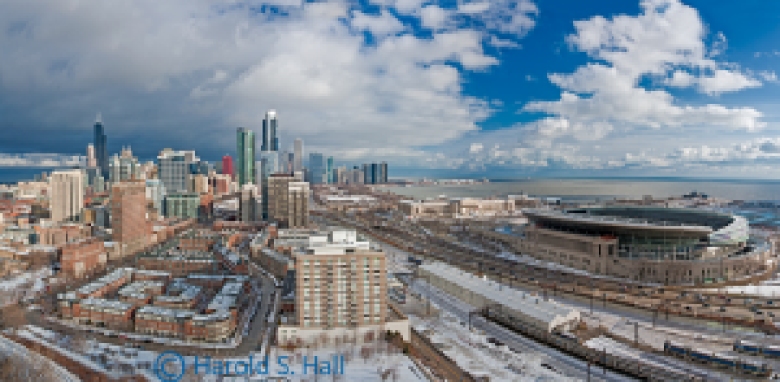
Gayle and I have lived for about a year on the south side of Chicago, in a new high-rise building across from Soldier Field, home of the Bears.  The views from our north facing balcony are incredible.  Each morning a new view awaits.  Click the link below to view my book at the BLURB.com WEB site.   When at the BLURB.com book site, click on the small box with the 4 arrows in the lower right to make the book fill your screen.  We have seen some incredible views from our home in the Museum Park neighborhood.  If you should wish to order this book, I recommend the hard cover with the dust jacket and upgraded paper, at least the Premium Luster or better the Pro Line Pearl.  The colors just look better.

Chicago - Prairie Avenue Morning

A winter morning view from the balcony.

To see the book in its entirety, click on the link below.

http://www.blurb.com/books/1622608

Chicago Blue Sky

Santa Fe Sky in Chicago